
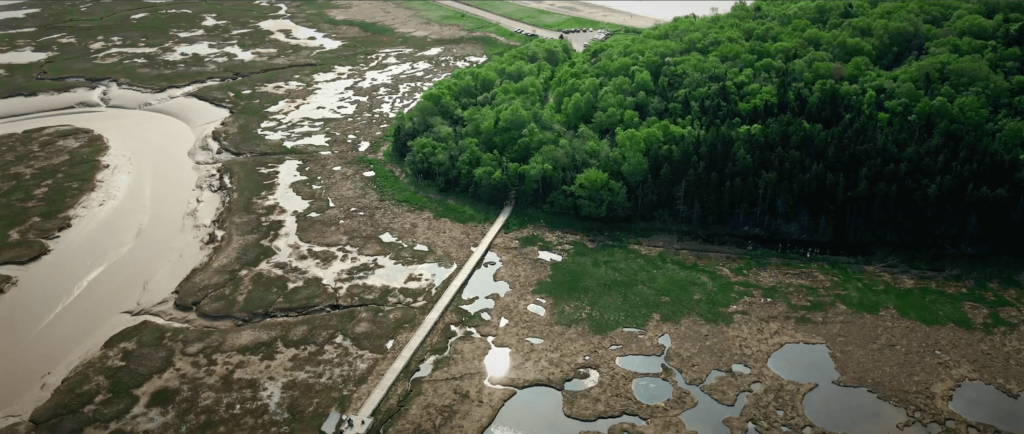



Reversing Falls

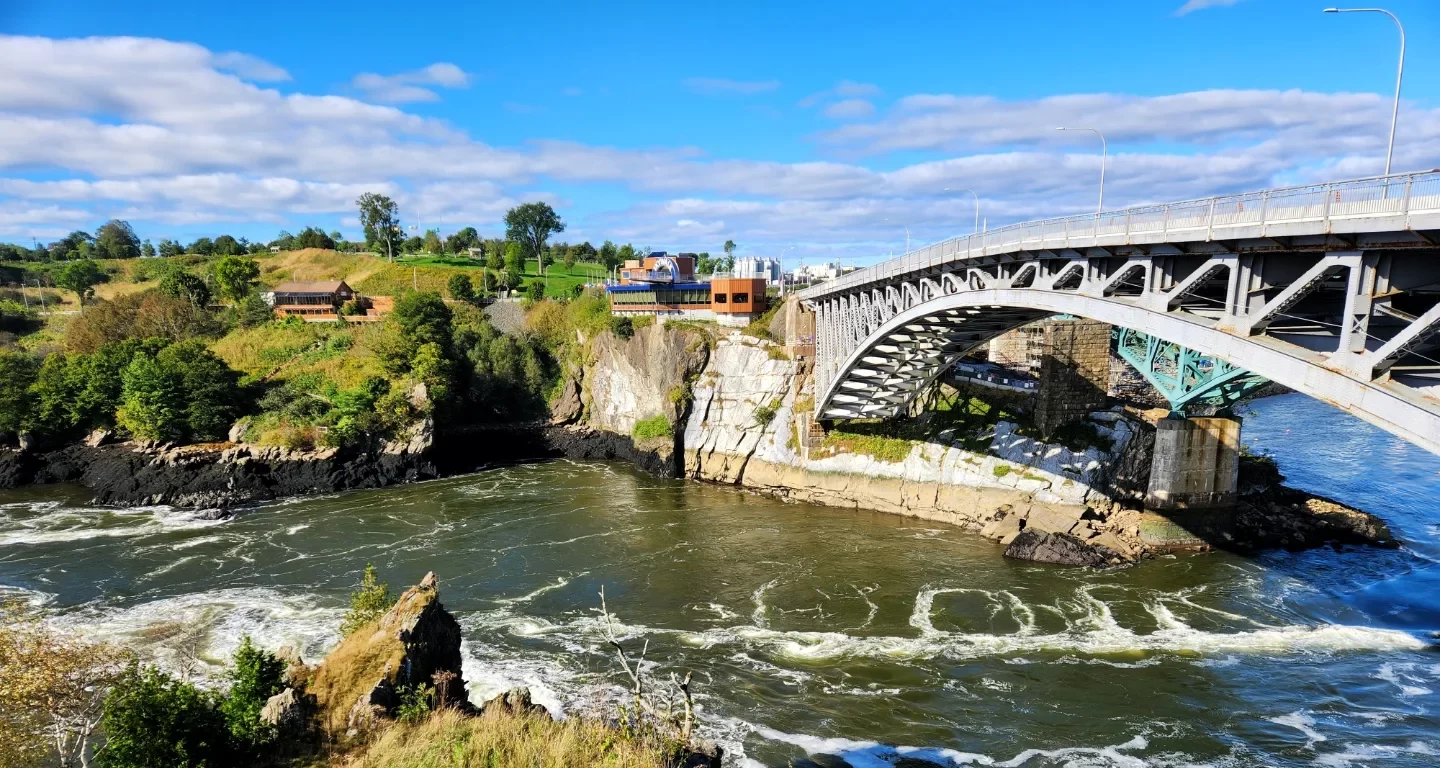
The Reversing Falls are really the heart of our geopark, tying various indigenous, settler, natural, and industrial stories back to the landscape. The phenomenon at the Reversing Falls, where the Bay of Fundy meets the St John River (or the Wolastoq), is an absolute must-see, while the stories behind its geological formation are truly fascinating. You’ll be able to say that you visited South America and Africa after a quick visit to this awesome site!
How to Get There
Views of the Reversing Falls are available on either side of the Reversing Bridge or at Fallsview Park off of Douglas Avenue. Each view tells a different story and is worth checking out! Our favourite time to visit the falls is at low or high tide in order to catch some spectacular rapids and whirlpools, but it’s also pretty cool to see the waters stand perfectly still and start to reverse direction at slack tide.
Geology
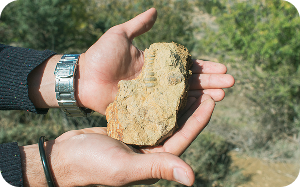
The Reversing Falls are famous for the tidal phenomenon that forces the St. John River to flow backwards as the Bay of Fundy reaches high tide. A much older geological story here involves the collision of ancient continents. The rocks at the Reversing Falls exhibit one of the most interesting stories in the Stonehammer Geopark. Here you can see the contact of two ancient geologic terranes, and the fault line that marks the boundary between them.
A terrane is a fragment of the Earth’s crust formed on, or broken off from, one piece of the Earth’s crust (or tectonic plate) and attached or welded to the crust on another plate. The rocks south of the bridge are Cambrian-age rocks, 542 to 490 million years old, that formed in what is now Northern Africa. North of the bridge, the light gray rocks are Precambrian-age marbles that are 750 million to 1.2 billion years old, which formed in what is now South America. At the Reversing Falls, we can see the contact of these two ancient continental fragments that were brought together as an ancient ocean closed and the supercontinent Pangea formed.
There is also an ice age story to be told here! About 20,000 years ago, the last glacial period reached its maximum. Glaciers covered all of the Maritimes. As the continental glaciers melted, they left a changed landscape. Before the last glaciation, the St. John River flowed to the sea through South Bay, past the Irving Nature Park. Glacial moraines damned that outlet. When the river found its new route 15,000 years ago, it flowed over the rock ridges at Reversing Falls to create a waterfall. As the sea level continued to rise and the riverbed was eroded, the waterfall was drowned. The phenomenon of the Reversing Falls is only about 3,000 years old. A profile of the river bed shows a series of three waterfalls that existed here, starting near the islands at Fallsview Park and ending near the bridges. Just past the islands, the river bottom drops to about 25 metres below the low water level. It then drops two more times to more than 40 metres below the low water level just past the road bridge.
History
There is an indigenous story passed down through the oral tradition that speaks of how the reversing falls formed
“In times long ago, beavers were huge animals that Wabanuwok feared. One beaver lived in a great lodge on an island in a smaller river joining the Wolastoq. Where the mouth of the Wolastoq foamed into rapids, the beaver decided to build a dam.
The people of the Wolastoq watched angrily as their beautiful camping grounds farther up the river valley were gradually flooded. Soon, the grounds would disappear under the water, then the whole country. They took their protests to Koluskap, who saw that this must not happen to his people. With one blow of his mighty club, he smashed the dam, and the river rushed out once again to the bay. The water carried a piece of the dam along with it right past the shore, where it finally came to rest as an island.
Other results came from that tremendous blow. Some of the flood water, farther up above the rapids, did not drain out, but remained as broad and shining lakes forever after. Also, the force of the blow broke off a piece of split rock beside the rapids.
But best of all, Koluskap, determined that beavers should never again have the power to endanger his people’s lives, made the beavers forever after animals of small size.”